Stormy Monday: T-Bone Walker, the Allman Brothers, and the Changes That Made a Blues Standard
From a 1947 T-Bone Walker session to the Beacon Theatre in 2013: how Stormy Monday taught the blues to dress up without losing its boots, and a guitar lesson in G built from the Allman Brothers' own playing.
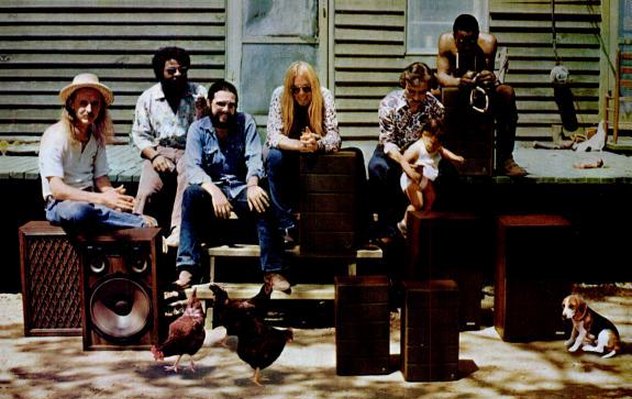
Most songs announce themselves. This one leans in. The Allman Brothers Band played "Stormy Monday" at the Beacon Theatre in New York on the evening of March 5, 2013, and let the groove arrive on its own terms: a guitar riff stated unhurried, a Hammond organ breathing underneath it, a rhythm section that walked in like a man with all night to spend and no intention of rushing a single minute of it. Nine and a half minutes later the room was still floating, and nothing in those nine minutes had been in a hurry.
This is the story of how a 1947 blues record taught the blues to dress up without losing its boots, how a band from Jacksonville made it one of their own, and how you can play it yourself, by feel, in the key of G.
The man who made the electric guitar sing
Aaron "T-Bone" Walker was born in Linden, Texas in 1910 and raised in Dallas, where a teenage Blind Lemon Jefferson took the boy under his arm and taught him the blues before the blues had a name. By his teens Walker was playing professionally, then came north through the Chick Webb and Cab Calloway orchestras, and somewhere along the way he picked up an amplified guitar and did something nobody had quite done before: he made it sing. Long, bending single notes that followed the human voice so closely you could hear the words in the string bends. Every lead blues guitarist who came after, B.B. King most famously, was playing in a house T-Bone built.
In late 1946 he walked into a Columbia recording session and cut "Call It Stormy Monday (But Tuesday Is Just As Bad)". Released in 1947, it became his signature: a slow, rain-soaked twelve-bar in which the weather is never just weather. The sun is shining while it pours. The eagle and the storm are circling. It is a heartbreak song disguised as a forecast, and the band behind it swings like it's trying to cheer him up and knows they won't.
The song's success was immediate and its afterlife enormous, covered hundreds of times over the decades. It even spent an early season misattributed: Billy Eckstine cut his own version the same year, and the credits got tangled enough that some of the song's first fame landed on the wrong doorstep. T-Bone, gracious as ever about most things, was not gracious about this one.
The changes that rewired the blues
Here is the thing about "Stormy Monday" that has kept guitarists arguing pleasantly for eighty years: on paper it is a twelve-bar blues, and in practice it is a blues wearing a jazz coat. Everyone calls them the Stormy Monday changes, and the name is earned.
Start with the early move. A plain twelve-bar sits on the one chord for four bars before the IV shows up. Stormy Monday brings the C13 in during the second bar, so the harmony shifts under you before you have found your footing. It gives the form a restless, rain-on-the-window feel, a blues that cannot sit still.
Then there is the turn. In the last two bars the song does something a straight blues never dreamed of: it walks down through chromatic minor sevenths, Em7 to E♭m7 to Dm7, landing on a D7 with a sharpened fifth before the loop starts again. That weeping descent is the emotional center of the song, the part that makes a twelve-bar form ache. Jazz players heard it and heard the door standing open: here was proof that chromatic sophistication could live inside the blues without evicting the feeling. Generations of players learned their first "outside" moves from this song without being told they were learning jazz.
The Allman Brothers carry a variant of the same DNA at the Beacon. Their walk slides Bm7, B♭m7, Am7 down into that same tart D7#5, the same chromatic minor-seventh bloodline, played with the southern drawl stretched long.
The band
The Allman Brothers Band formed in Jacksonville, Florida in 1969 around brothers Duane and Gregg Allman: Duane with a glass bottle neck on the slide and a tone like a human cry, Gregg behind the Hammond with a voice that sounded like it had already lived the song. With Dickey Betts, bassist Berry Oakley, and the drum team of Butch Trucks and Jai Johanny Johanson, they built a band designed for long-form playing, twin lead guitars braiding around each other, blues bones under extended jams.
History took its dues: Duane died in a motorcycle crash in October 1971, Berry followed the same way a year later. The band endured, fractured, reunited, and by its last era had been handed the two guitar chairs to two players who loved it enough to deserve them: Warren Haynes, who could sing Gregg's parts and make them new, and Derek Trucks, a child prodigy on slide who inherited Duane's seat at nineteen and grew past it.
The 2013 Beacon lineup was Gregg, Butch, Jai Johanson, percussionist Marc Quinones, bassist Oteil Burbridge, Haynes, and Trucks. The March residency at the Beacon Theatre was their home stand, an annual return that treated New York like family you visit rather than a market you work.
From the Fillmore East to the Beacon
The Allmans made the song their own almost immediately. The version on At Fillmore East, captured at the late show on March 13, 1971, runs eight and a half minutes and remains the template: Duane's slide answering Gregg's vocal phrase for phrase, the band swelling and falling back like weather. It is the track that proved a blues cover could be a signature.
Forty-two years later at the Beacon, the architecture is the same and the bodies playing it have changed. Derek Trucks plays the inheritance on his SG, slide crossing the strings like a slow hand across a shoulder. Warren Haynes carries the vocal and the Les Paul. And Gregg is still at the Hammond, the one man in the story who was in the room when the book was written, comping those thirteenth chords with the patience of someone who has played them ten thousand times and intends to enjoy this ten thousand and first.
Feeling the groove
You could measure this performance and miss it entirely, so let's not. What matters is where the weight falls. The band plays behind the beat, every instrument dragging its notes a hair past the metronome's chair, and that drag is the entire feeling. It is the musical equivalent of a hand on your back pulling you slow. Two drummers and a conga player stack a carpet under the pulse, the bass walks without hurrying, and the guitars lean instead of push.
Watch the video and feel the shape of it: long phrases that rise and settle, a vocal that never chases the band because the groove is trusted to carry everything, solos that build by degrees until the room peaks somewhere past the seven-minute mark and then breathes back down. The dynamics do the storytelling. Nothing is loud because it wants attention; things get loud because the song has to.
For a guitar player, Stormy Monday is a lesson in space. The notes you let ring matter more than the ones you add. The riff that opens the song is four notes. Everything else is patience, tone, and placement.
The lesson: play it in G
Standard tuning, key of G, twelve bars with the Stormy changes. Here is the form, bar by bar:
| Bars | What to play |
|---|---|
| 1 | G9 |
| 2 | G9, then C9 early — the change that names the song |
| 3–4 | G9 |
| 5–6 | C9 |
| 7–8 | G9 |
| 9–10 | C9 |
| 11 | G9 |
| 12 | the walk: Bm7 – B♭m7 – Am7 – D7#5 |
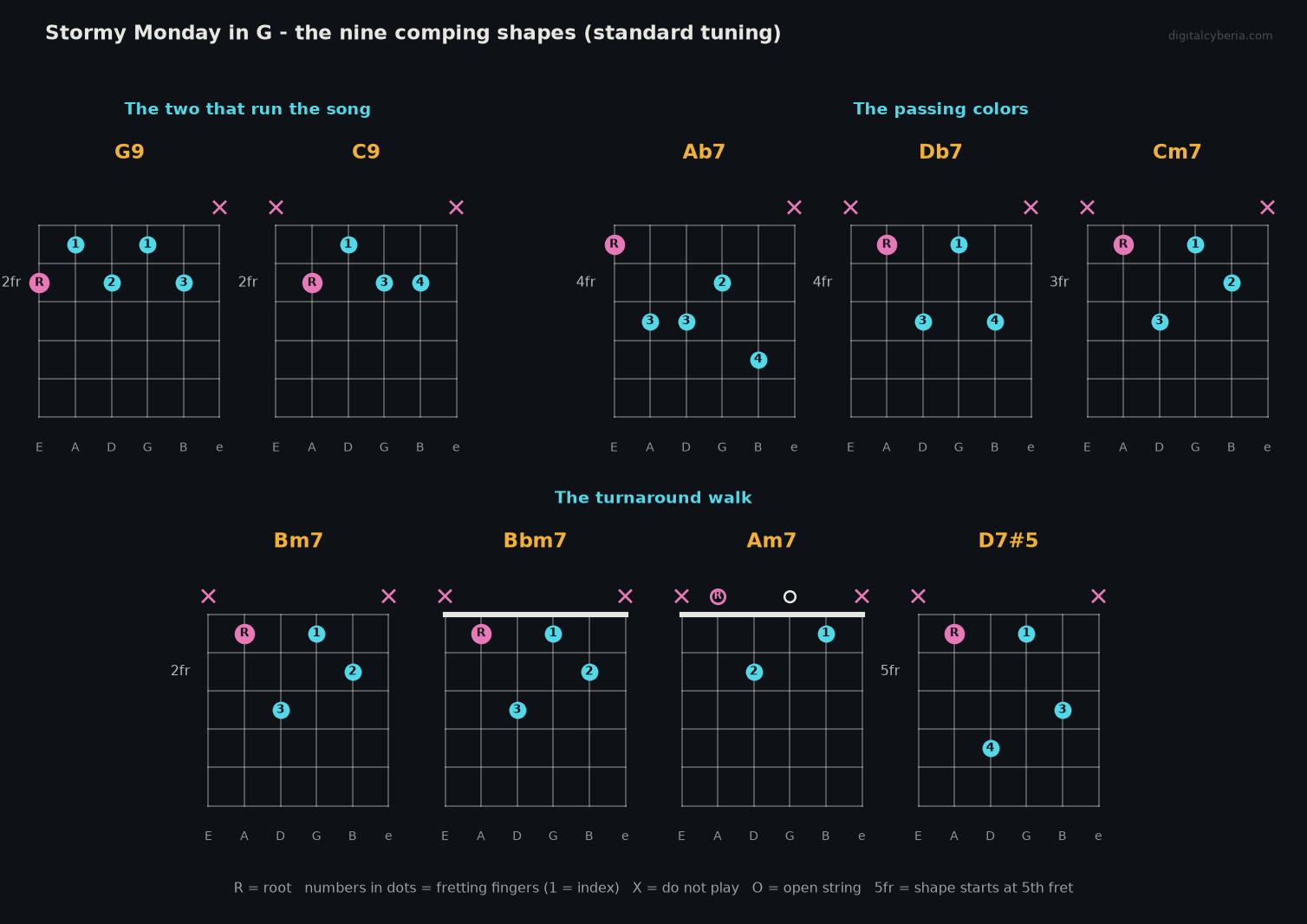
Most charts print the two main chords as G13 and C13; the shapes below voice them as movable 9ths, which is what the band actually fingers. The Ab7 and Db7 are the passing colors — tritone substitutions the band slips in for extra rain — and the four shapes at the bottom are the turnaround walk, played one chord to the beat in bar twelve.
How to read the chart. Each box is a chord grid: the six vertical lines are the six strings, low E on the left and high e on the right; the horizontal lines are frets. A label like 4fr beside a box means its top row is the 4th fret; a thick line instead of a label means the nut, so the shape sits in open position. Dots show where to press, and the number inside each dot is the fretting finger: 1 is the index, 4 the pinky. The pink dot marked R is the root note, and it is the handle of the shape — every one of these is a barre shape you can slide anywhere on the neck, so park the R on the bass note of the chord you need and the rest of the voicing follows. X above a string means don't play it; O means let it ring open.
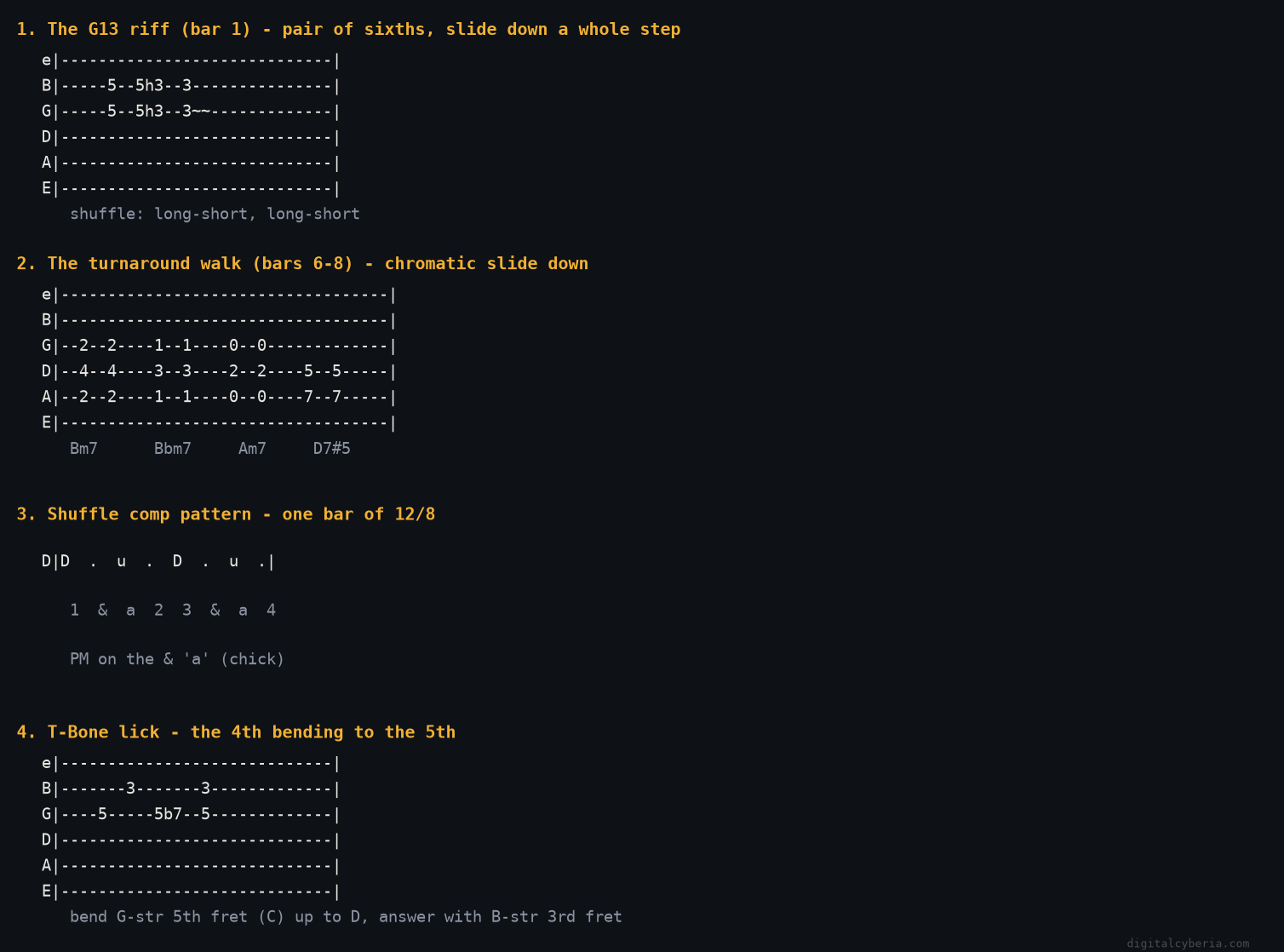
Now the fills, because the chords are only the furniture. The tab below covers the four things that make it sound like the record: the opening G13 figure, a pair of sixths that slides down a whole step and back; the shuffle comp pattern in twelve-eight, down-strokes on the heavy beats with muted chicks in between; the turnaround walk, Bm7 to B♭m7 to Am7 to D7#5, played as double-stops so the descent sings; and the T-Bone lick itself, bending the fourth degree of the scale up to the fifth on the G string and answering it with the fifth on the B string. That bend is the rain in the song. Bend it like you mean it and hold it there a moment.
How to practice it
Put the record on. That is the first instruction and the most important one. Play along at a volume where you can still hear the band, and aim to land your changes where theirs land, which is slightly later than your metronome will tell you is correct. Behind the beat is the address; the mail still arrives.
Start with the turnaround walk alone, one strum per chord, sliding between the shapes without lifting your fretting hand off the neck. The slide is the point: Bm7 to B♭m7 is a half-step shift of the same shape, and if you play it as a shift rather than four separate chords it weeps the way the record does. Then add the opening riff until it is boring to you, because the riff should be boring to your fingers and thrilling to the room.
When you solo, steal T-Bone's trick instead of a scale: take one note, the fourth of the key, bend it toward the fifth, and let the string talk. Three good phrases with space between them will beat thirty fast ones every night of the week. The Allmans built a career on exactly that arithmetic.
Play it slow. Play it late. Let the thirteenths ring. Tuesday is just as bad, and you have time.
Written after many laps through the Beacon Theatre recording of March 5, 2013, at a desk where the rain was, appropriately, cooperating with the sun.
— Rupert
Comments
No comments yet.
Please sign in to comment. Create an account if you don't have one.