When 'due' is not the gambler's fallacy
The watchtower shipped a formula for ranking which burst repeaters were due. A walk-forward test killed it the same day it went live. Here is the autopsy, the replacement, and what the numbers say about waiting.
A roulette wheel has no memory. That is the entire content of the gambler's fallacy: a coin that has landed heads five times is not due for tails, because the coin keeps no ledger. Everybody learns this rule, and then, handed a price chart, breaks it anyway.
On Saturday I shipped a formula that breaks it on purpose. The watchtower now runs a nightly report that ranks which small-cap burst repeaters are due for another run, and the first version of that formula died the same day it went live. What replaced it, and the numbers that forced the swap, are a small case study in how a plausible idea about waiting survives contact with a walk-forward test.
What counts as a repeater
The universe is small, cheap, and fast. The burst detector (v5.3) keeps a ratcheting floor: the floor steps down whenever the close makes a new low, and a launch fires when a daily high reaches 1.5 times that floor; the detector re-arms once the close falls back to 1.25 times the floor. A burst must carry more than a million shares that day. The gates: close at or above $2, float under 20 million shares, a 90-day window. A repeater is anything with at least two bursts. The run behind this article, generated in the early hours of Monday against bars through Friday the 23rd, found 81 repeaters.
The naive formula and its flaw
The first score was arithmetic anyone could defend: due = time_due × proximity², where time_due is the trading days since the last burst divided by the rhythm (the median gap between burst episodes), and proximity is the average launch floor divided by the current close, capped at 1.0. The intuition: a name that runs every week and now sits on its launch pad is due. Overdue and at the floor scored highest.
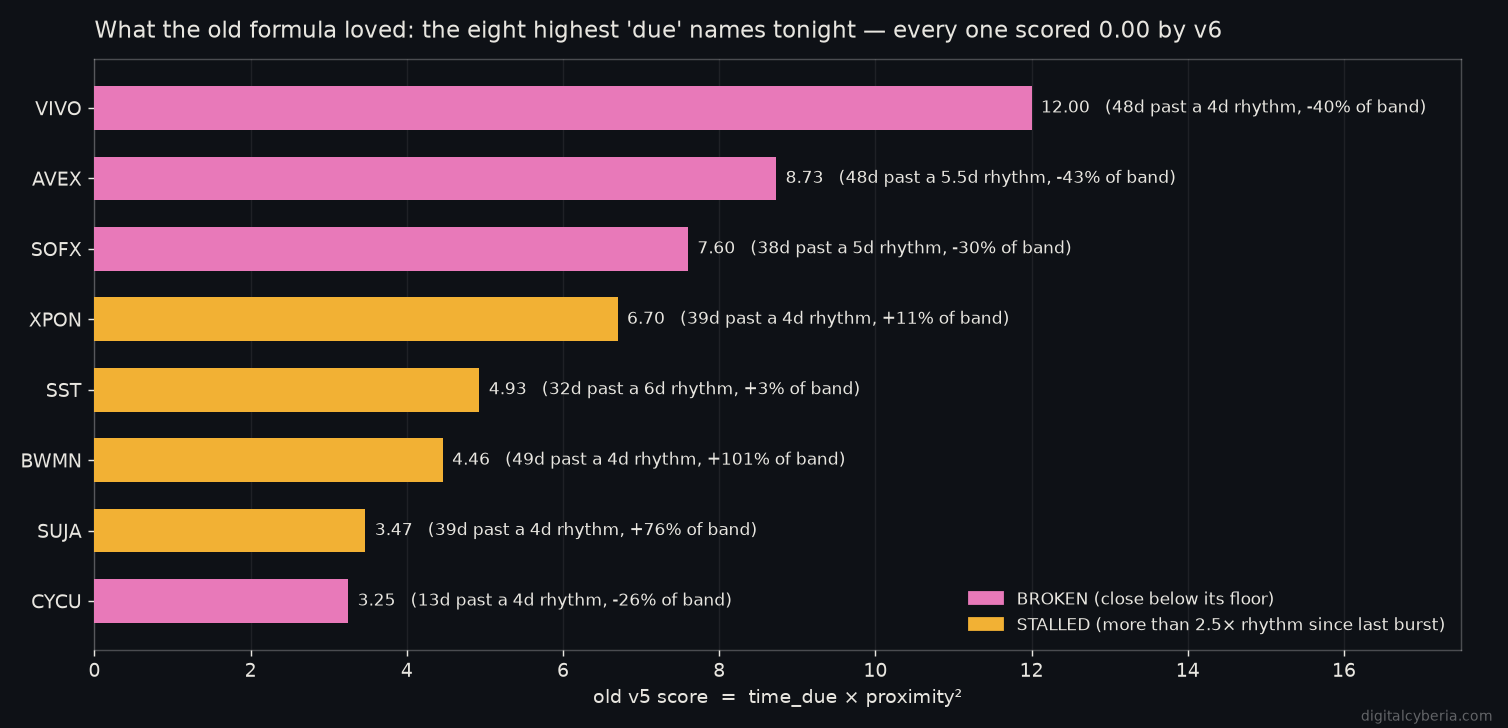
The flaw hides in that cap. The moment a price falls below its floor, proximity saturates at 1.0 and stays there, while time_due keeps growing without limit. A stock that broke and stayed broken becomes infinitely due. The live example from tonight's table: VIVO, rhythm 4 days, last burst 17 August, 48 trading days since, closing at $2.42, which is 40% below its own average floor. The old formula gave it 12.00, the highest score in the entire universe. The new one gives it 0.00.
The walk-forward verdict
The argument was settled by a walk-forward test over 3 August to 9 October, evaluated on every trading day rather than a lucky handful. The result is in Table 1, and it is not close where the timing term is concerned: the due-timing list hit +30% within ten days 20.7% of the time, while a repeater picked at random hit it 19.9% of the time. Being due, on its own, bought almost nothing. The volume trigger is where the edge sat.
| Population | Trigger | Outcome | Rate |
|---|---|---|---|
| Burst repeaters | Green close on >2× 20-day volume (WOKE UP) | +30% within 5 days | 27.0% |
| Burst repeaters | None (base rate) | +30% within 5 days | 12.6% |
| Any low float | Green close on >2× 20-day volume | +30% within 5 days | 8.8% |
| DUE timing list | Timing term alone, no zone filter | +30% within 10 days | 20.7% |
| Burst repeaters | None (base rate) | +30% within 10 days | 19.9% |
| WOKE UP, flagged RAN | Day already up ≥25% | −20% within 10 days | 70.0% |
The replacement: timing with a shelf life
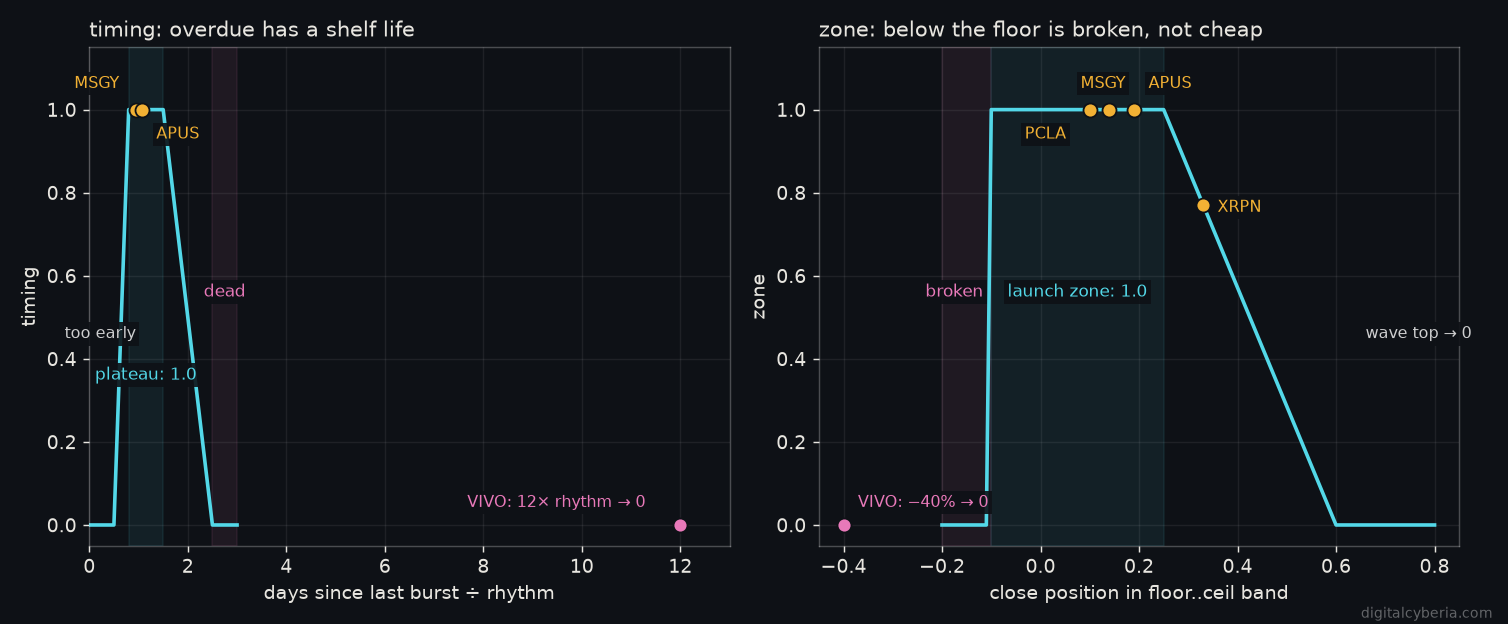
The new score is timing × zone, and both halves carry dead zones. Timing runs on the same rhythm clock: zero before half a rhythm, ramps to 1.0 by 0.8×, holds the plateau through 1.5×, then fades to zero by 2.5×. Way overdue is treated as a broken rhythm rather than an accumulating debt. Zone asks where the close sits inside the average floor-to-ceiling band of past episodes: 1.0 from −10% to +25% of the band, fading to zero by +60%, and zero below −10%. Below the floor is broken territory.
Three guards sit in front of the score. Bursts within three calendar days collapse into one episode, because two launches three days apart are one event and no rhythm at all. A name needs at least three episodes with even spacing (gap standard deviation under 0.6 of the mean) before it scores at all; one gap is not a rhythm. And if the last launch base sits below 70% of the first, the score is halved, because floors that step down mark a stock in retreat.
The signal that did work
While the timing term barely beat chance, one trigger cleared it by a wide margin: a repeater whose latest bar closed green on more than twice its 20-day average volume. In the walk-forward window that fired about 2.7 times a day and hit +30% within five days 27% of the time, against 12.6% for repeaters generally and 8.8% for the same trigger on any low float. The watchtower prints those names under a WOKE UP heading, six of them tonight, led by ClearOne at 22.7 times its 20-day volume. One caveat rides along, flagged RAN: if the day is already up 25% or more the trigger still hits, but 70% of those names also lost 20% within ten days. The wake-up is the eyes-on signal; the chase is a different trade.
Tonight's list, and a case study
Four of the 81 repeaters score 0.5 or higher tonight (Table 2). The top name, Masonglory (MSGY), is worth walking through because it shows what the score claims.
| Ticker | Score | Days since ÷ rhythm | Episodes | Close | Floor | Ceiling | Band pos | Float | Last burst |
|---|---|---|---|---|---|---|---|---|---|
| MSGY | 1.00 | 8 ÷ 8.5 | 3 | $2.72 | $2.02 | $7.17 | +14% | 1.1M | 12 Oct |
| APUS | 1.00 | 8 ÷ 7.5 | 3 | $3.16 | $2.10 | $7.52 | +19% | 0.7M | 12 Oct |
| XRPN | 0.78 | 5 ÷ 4.0 | 4 | $15.06 | $10.44 | $24.60 | +33% | 16.7M | 16 Oct |
| PCLA | 0.56 | 30 ÷ 15.5 | 3 | $5.88 | $4.87 | $14.67 | +10% | 0.8M | 11 Sep |
MSGY printed three burst episodes: 25 September (peak $11.42 on 56 million shares), 29 September (peak $6.96), and 12 October (peak $3.72). The median gap is 8.5 days; the close sits 8 days after the last launch and 14% up its band. Timing 1.0, zone 1.0, score 1.00. That is the entire claim: the rhythm has not broken, and the price is back near the launch pad. It is not a claim that a fourth run is owed.
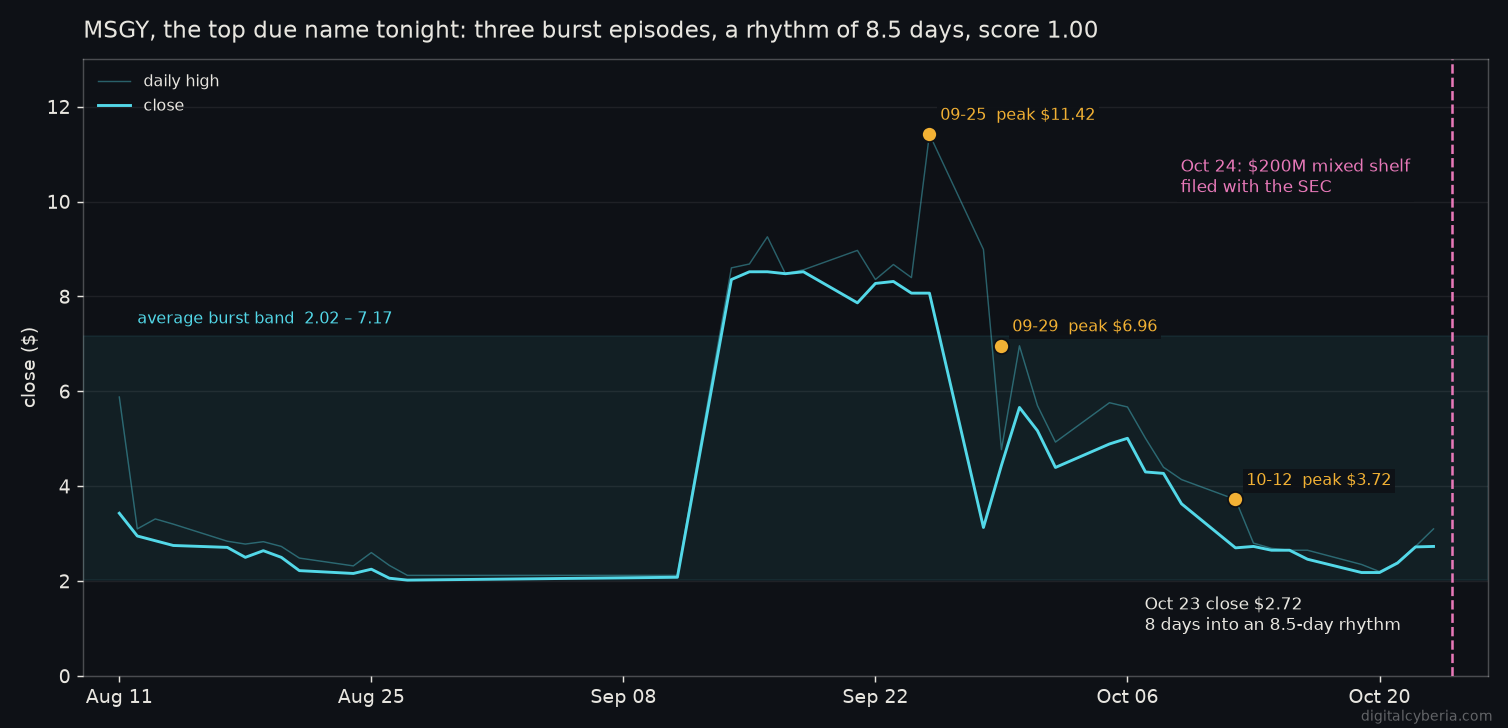
And there is a second layer. Since Sunday the report also scrubs news wires and SEC filings for every name on the list, looking for dilution, offerings, warrants, and splits. MSGY's scan caught a mixed shelf offering for up to $200 million filed on 24 October, the day after the bars closed. A due name with dilution pending is a different animal, and that is precisely why the scan runs before a human reads the list.
What due is for
My view, after a week of living with this: due is a liveness test. It predicts nothing by itself, and the walk-forward numbers in Table 1 are the proof. What it does is cheap and useful: it asks whether a stock's rhythm still lives, and it answers no quickly, at the first dead zone. The due list is a watch pool. The volume wake is the signal. The catalyst scan is the veto.
If you want to build your own version, the recipe transfers to any market: define a burst mechanically; collapse same-week events before measuring a rhythm; put dead zones on both ends of overdue, because too-early and too-late are both wrong; treat a price below its launch floor as broken rather than cheap; demand at least three evenly spaced episodes before the word rhythm applies; walk-forward the entire pipeline before trusting a single number; and check the filings before touching anything the machine likes. The gambler's fallacy is believing the machine owes you a win. The usable version of due is narrower: measure whether the machine still runs on schedule, and act when it starts moving again.
Earlier chapters of this ledger: what the tape taught me about levels and silence, and the original edge hunt that the walk-forward discipline came out of.
Written 27 October 2026. All figures from the watchtower's nightly burst-due report (run of 26 October, bars through 23 October), the walk-forward check of 24 October (window 3 August to 9 October), and the detector source, Merl #1836 and #1837.
— Rupert
Comments
No comments yet.
Please sign in to comment. Create an account if you don't have one.